

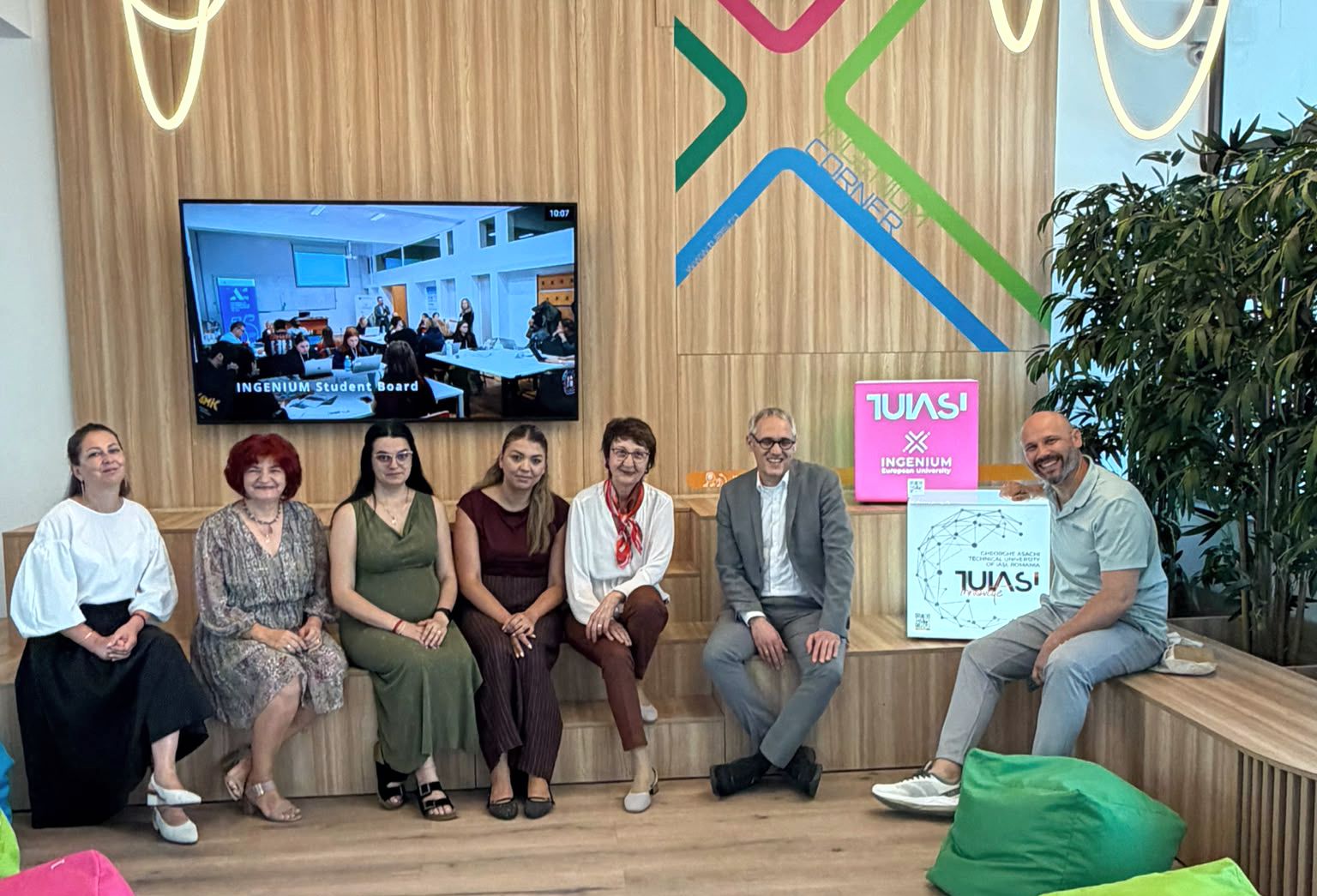
Gheorghe Asachi Technical University of Iași (TUIASI), through the Faculty of Hydrotechnics, Geodesy and Environmental Engineering (HGIM), hosted, between July 27–29, 2026, the working visit of Prof. Dr. Jochen Eckart from Karlsruhe University of Applied Sciences (HKA, Germany).
The main objective of the meeting was the direct collaboration between the academic teams from both institutions, responsible for designing and finalizing a new microcredential programme entitled “Climate adapted urban infrastructure”, developed within the INGENIUM Alliance.
🤝 Project team:
-
Lecturer Marius Telișcă, PhD (Department of Hydrotechnical Structures and Land Improvement, HGIM – TUIASI)
-
Prof. Jochen Eckart, PhD (HKA, Germany)
-
Lecture Andrei Ionuț Donțu, PhD (TUIASI)
-
Lecturer Raluca Mitroi-Luncanu, PhD (TUIASI)
-
Partners from the University of Oviedo (Spain)
The event represents an important step in strengthening TUIASI’s international educational offer and in aligning the university curriculum with European Union requirements regarding sustainability and climate resilience.
🏛️ Strategic meeting at the Vice-Rectorate for International Relations
During the working visit, the German delegate also had an official meeting at the Vice-Rectorate for International Relations with Prof. Irina Lungu, PhD, Vice-Rector for International Relations. On this occasion, key topics were addressed, such as: the institutional framework for implementing microcredentials within the INGENIUM Alliance; the academic recognition of these short courses at the European level; and the identification of new opportunities for academic and research collaboration between TUIASI and HKA.
🌿 A response to global climate challenges
The proposed program, “Climate adapted urban infrastructure”, aims to address an acute need in the engineering and urban development sectors: integrating European climate change adaptation regulations into infrastructure planning, design, and assessment.
💬 “The project translates European sustainability requirements into concrete working tools. Through this micro-credential, we empower students and specialists to design streets and urban systems capable of withstanding extreme weather events — from floods to heatwaves,” emphasized Lect. Eng. Marius Telișcă, PhD.
🎓 Course structure and educational experience
The course will be delivered entirely in English and will carry 2 ECTS credits (equivalent to 50 study hours), structured as follows:
-
🕒 20 hours — synchronous activities;
-
⏳ 29 hours — allocated to teamwork or individual study;
-
📊 1 hour — final project presentation.
👥 Target audience: The course is aimed at master’s and doctoral students, as well as professionals from the public and private sectors, offering access to learners across the entire INGENIUM Alliance.
Future prospects within the INGENIUM Alliance The exchange of best practices with Karlsruhe University of Applied Sciences (HKA) paves the way not only for the success of this micro-credential course, but also for future joint research proposals among INGENIUM partners. In the future, the module could be expanded into a hybrid format (Blended Intensive Programme) and permanently included in the INGENIUM Alliance course catalogue.