

“Gheorghe Asachi” Technical University of Iași hosted the second edition of the Mad Science International Interdisciplinary Conference from June 5–7, 2026, bringing together researchers, academics, and doctoral students from Romania and abroad to examine the impact of science and technology on contemporary society.
Organized by the Department for Teacher Training – Foreign Languages, the LINGUATEK Center for Applied Modern Languages and Communication, and CRU (Centre de Réussite Universitaire) TUIASI, Mad Science further strengthened its position as a platform for interdisciplinary dialogue, bringing together specialists from a wide range of fields, from history, cultural studies, literature, linguistics, film studies to pedagogy, anthropology, and economics.
Central Topic: “Biology, Technology, Systems of Power”
The central topic of this year’s edition, “Biology, Technology, Systems of Power” provided a framework for discussions on the complex relationships between biology, technology, artificial intelligence, the environment, education, and contemporary structures of power and control. Conference presentations were organized into sessions held in English, French, and Romanian, both in person and online.
Guest of Honor
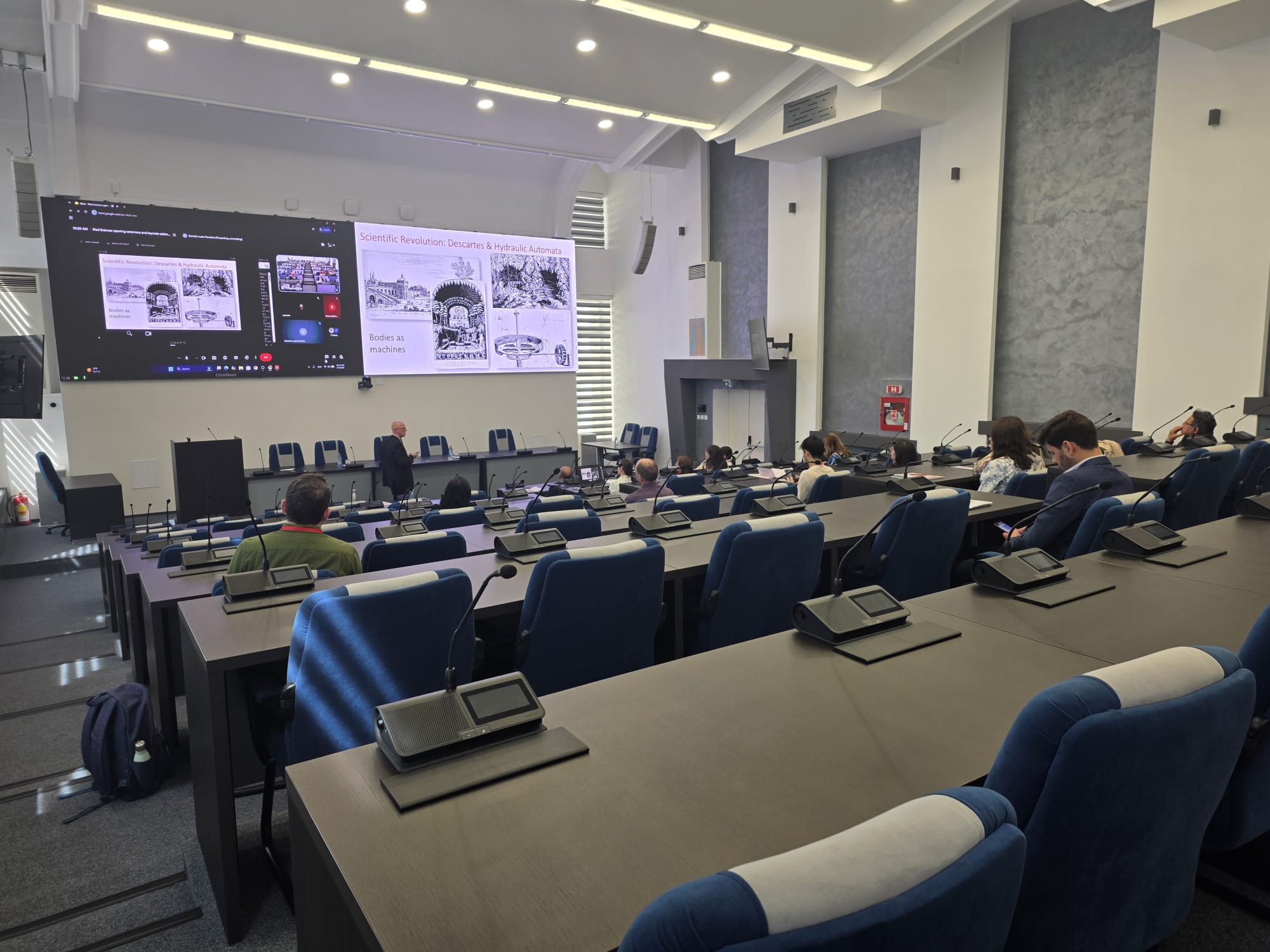
A highlight of the event was the keynote address delivered by Professor Carsten Timmermann from the Centre for the History of Science, Technology and Medicine, University of Manchester (United Kingdom). His presentation, entitled “Mechanical Bodies and Biological Systems: Machine Metaphors in the History of Biomedicine, and Why They Do and Don’t Work,” explored how mechanical metaphors have shaped our understanding of the human body and influenced the development of modern biomedicine.
Other guests and researchers
The conference’s international aspect was reinforced by the participation of guests and researchers from several countries. Among them was Matthew Hayes from Northern Lakes College (Canada), who presented on conspiracy imaginaries and contemporary technological representations, as well as Alexandre Mora, doctoral student affiliated with the University of St. Andrews and the University of the Basque Country, who examined the relationships between science, power, and violence in French literature of the Enlightenment.
The program also featured online presentations by researchers from academic institutions in France, the United Kingdom, South Africa, Egypt, and Côte d’Ivoire. Participants included Hervé Goerger (Sorbonne Nouvelle University), Carmi Britz (Central University of Technology, South Africa), Enzo Le Guiriec (Université Lyon 3, France), Dieudonné-Désiré Amani (Université Alassane Ouattara de Bouaké, Côte d’Ivoire), and Hesham Ahmed (Egyptian International school, Egypt). Their contributions helped expand academic dialogue beyond the European sphere and further strengthened the conference’s international scope.
Thematic Panels and Current Topics
The conference featured panels dedicated to a range of highly relevant topics, including:
- Gender and ecology in the Anthropocene;
- The impact of technology on history, education, and society;
- Technology, discourse, and narratives of control;
- Bio-hybrid identities in the age of posthumanism;
- Bodies and technology;
- Technology, pedagogy, and the workforce;
- From posthumanism to generative artificial intelligence;
- Literature, technology, and society.
The event also included a workshop for French language teachers, academic visits, and networking activities, fostering collaboration among researchers and institutions from diverse cultural and academic backgrounds.
The strong international participation, the diversity of topics addressed, and the high quality of the discussions confirmed TUIASI’s role as a space for international academic dialogue and interdisciplinary research. Through the organization of the Mad Science conference, “Gheorghe Asachi” Technical University of Iași reaffirms its commitment to internationalization, the promotion of academic excellence, and the support of research communities capable of addressing the challenges of contemporary society.
The second edition of the conference demonstrates that Mad Science has moved beyond the status of an emerging academic initiative and is establishing itself as an international event with significant potential for growth and impact within the European interdisciplinary research landscape.